Showing posts with label 1940s. Show all posts

Monday, 4 November 2019

WW2 Gordon tartan ATS skirt


Pattern: improvised based on standard ATS skirt
Fabric: a 100% wool Gordon tartan skirt
Haberdasheries: one button, two snaps, white  petersham ribbon (4 cm wide)

As you may know from previous posts, I’ve been doing QAIMNS, VAD and WLA for a while, but more recently I’ve started getting into other WW2 women’s uniforms as well. I’ve got the well-known book World War II British Women’s Uniforms, and there’s a picture in there of an ‘ATS officer, Scottish Command’ which I thought it would be really awesome to make a Gordon version of. Which meant getting a side cap and making a kick-pleated Gordon tartan skirt!

It isn’t that easy to find the right fabric for a skirt like this, so I got an existing skirt from eBay which was basically a women’s kilt:


I took it apart and then made a pattern based on my standard ATS skirt, adding kick-pleats at all four front and back seams using this tutorial.

The fabric passed the cat test

One set of pleats close up

To create a neat skirt, I needed the yellow lines in the tartan to line up at the seams. My regular method of simply placing pins at those lines and sewing over them (carefully) didn’t work for this fabric (it moved, despite the pins) so I ended up using thin double-sides adhesive tape, which worked surprisingly well! I just sewed over it and tore the tape away afterwards.

The double-sided adhesive tape in action

This 1941 fragment of ATS girls sewing their own ‘kilts’ was of some help in making my skirt, but as I couldn’t see all the details or find any photos of an original skirt anywhere, I had to make a few assumptions. Like in the standard ATS skirt, I made a front opening with a button (black version of the standard battledress button) and two snaps and finished the waist with white petersham ribbon. Finally, I used the eBay skirt’s existing hem!


I love, love, love this uniform! I think it’s so lovely and flattering. Apparently the ATS uniform jacket didn’t live up to the wartime fashion and beauty standard at all, and people did not think was flattering at the time, as is accounted on pages 144-5 of Virginia Nicholson’s very interesting book Millions Like Us:
For a surprising number of women the main factor influencing their choice of what service to join “was the clothes. Few of them knew what to expect, so they judged on appearances. Christian Oldham (…) joined the Wrens in 1940. Years later, when she published an account of her time with the service, Christian couldn’t decide what to call it, until she casually mentioned to her editor, ‘You know, I only joined for the hat.’ They both agreed it would make the perfect title.
Christian Oldham claims to have been ‘hat-minded’ from the age of three. At twenty she was even more susceptible to the flattering double-breasted tailored jacket, svelte skirt and pert tricorne hat that comprised the officers’ uniform. Vera Laughton Mathews, director of the Wrens, had commissioned the elite fashion designer Edward Molyneux to come up with the look. ‘The effect was a winner,’ according to Christian, and entirely accounted for the huge waiting list of applicants wishing to join:
‘The great thing was, of course, that the ATS and WAAFs had these frightful belts which made their bottoms look enormous, whereas the Wrens had this nice straight uniform which concealed your worst points. Joining the Wrens was quite the most fashionable war work.’
Admittedly, the ATS uniform lacked pulling power: in truth, a single-breasted, belted khaki jacked bulked out with cumbersome pleated pockets did nothing for one’s figure. The WAAFs suffered from the same defect where pockets and belts were concerned, accentuating hips and bottoms.”
How things change! Or maybe it’s just my taste and my not overly busty and hippy figure, but the Wren (Women’s Royal Naval Service) uniform is my least favourite and I don’t think either the double breasted jacket or the hat flattering! What’s not to love about the ATS jacket, which cinches one’s waist while, indeed, adding to bust and hips? It certainly works for my 8 figure.

If you want to know more about women in the wartime services, I recommend the aforementioned Millions Like Us, a very nice read indeed!

The jacket, side cap and tie are original, the shirt and shoes are post-war military issue, the lanyard is a reproduction by my friend Anne, and the bag is from Soldier of Fortune. I certainly don’t think all their reproduction stuff is good (the ATS caps, for instance, are awful) but they did a decent job on the bag. Also, original bags tend to have lots of stains and look about as old as they are now, but I want to look like I’m wearing this uniform sometime between 1940 and 1945!

What I should add, by the way, is that these skirts, as well as the side caps, were ‘private purchase’, so non-standard items, and were only worn in Scotland, and not overseas.


Aaand when I got home I put my jacket on my ironing board to vent, and the obvious thing happened… :P


Saturday, 31 August 2019

1940s half slip


Pattern: improvised
Fabric: white viscose dyed powder pink
Haberdasheries: two snaps, one hook, 1.4 m light pink lace, elastic for the waist

Hey y’all, I took a bit of a break from blogging because it was feeling too much like a chore and I wanted to focus more on sewing rather than writing about it. But now I’m back and have quite a few unblogged projects, so you can expect many more posts the coming time.

One of the things I’ve made is a 1940s half slip. I improvised the pattern, which is a simple A line skirt. I used a white viscose fabric which I dyed powder pink using Dylon fabric dye in the colour powder pink :P. Strangely this colour, among a few others, is not sold in my country so I had to get it from eBay. I used this colour before to dye some granny underwear from Hema that I use with 1940s clothes (see here) and the colour turned out much brighter, and also a different shade (less peach pink), on that cotton fabric than on this viscose, but the resulting very light pink was what I was going for. It’s a classic 1940s underwear colour.


I made French seams because the fabric is quite thin and sheer, and a placket with snap fasteners and a hook and worked eye to close the slip. I might replace the snaps with more hooks and eyes though, because they have a tendency to pop open when I sit down!


I learned a ‘couture’ technique for sewing on hooks for this project. Doesn’t it look nice?

Wednesday, 19 June 2019

Women’s Land Army jumper – and how you can make your own!

Pattern: none
Fabric: a 100% wool knit Dutch army sweater
Haberdasheries: none


Yes, finally I’ve got a WLA jumper! (And finally my uniform contains one piece that is actually my colour! :P) In my opinion this is one of the hardest WLA uniform pieces to obtain, because there are no good reproductions available. Some web shops do offer them, but unfortunately the only thing they’ve got in common with the real thing is that they’re green and sometimes ribbed. However, they’re always made of cotton whereas original WLA sweaters were made of wool (and I know which I prefer for re-enactment events as well!), and even if they’re ribbed, the rib used is not the same at all.

So I’d been thinking about how I was going to make a good WLA jumper. There were hand knitting patterns for them at the time, but I didn’t feel like knitting one because frankly, an entire sweater in k1p1 is just boring! Then my husband mentioned he had an old Dutch army sweater lying around that he wasn’t using anymore, and it turned out to be 100% superwash wool and exactly the right fisherman’s rib!

This is what the sweater looked like, nice Dutch flag and all :P:


I removed the stitched on cotton pieces and took the jumper apart, then sewed it back together, making it much smaller. Luckily, as the army sweater was too long anyway, I could omit using the part of the body which had the shoulder pieces, as the stitching left dents which even blocking didn’t remove. This was also the case with the sleeves, but I couldn’t avoid using those bits.

Creating the v-neck collar took the most effort. I carefully took off the collar, threading all its loops with scrap yarn, then made the v-shape and hand sewed the collar onto the jumper, taking care to reattach each loop.

And then all that had to be done was dyeing the jumper the correct shade of green! I say ‘all’, but this took some experimentation. I had experience with Dylon textile dye and although it isn’t meant specifically for wool I assumed it would work. The packaging says that ‘lighter shades will be achieved in wool’, so I thought I’d just add a bit more dye than specified. I did several dye tests on leftover bits of the army sweater, using varying ratios of Dark Green, Emerald Green and Tropical Green – and found that using Dylon in a lighter, bright colour in order to add intensity doesn’t work at all. Eventually I got a relatively bright green, but I had used so much Dylon dye to achieve this in the sample that to dye the entire jumper would have taken 50-70 euros worth of dye! Obviously that wasn’t an option, so I searched online for dye that was meant specifically for wool, and came across STV Jaquard wooldye. I ordered one bag in the colour ‘vogelmuur’ (chickweed – heh, that’s actually appropriate for the WLA in more ways than one!). 20 grams, that was supposed to be more than enough to dye my 425 g jumper. I found that hard to believe. Also, the fabric had to be heated to 98°C for the dye to work properly, and I assumed it would felt, or at least shrink. But I used 1 gram of dye for another sample and it came out the perfect colour, with seemingly no shrinkage!

My dye tests. Top left is the original colour of the army sweater, 1-4 are tests with Dylon and bottom right is the final test, using wool dye

Dyeing the entire jumper with the wool dye was still a bit tricky because the largest pan I own was only just big enough to fit the jumper and enough water to cover it; it was a more cramped space than is usually the case when I use Dylon in my sink and I couldn’t really stir the jumper properly, so I was afraid it might end up with a slight tie-dye effect of more intense colour in some places than others. Also, despite using a meat thermometer, the pot accidentally started boiling. But despite all this, the jumper cane out absolutely perfect! I’m quite astonished by the quality of this dye, how little of it I needed and how even the result was despite the jumper being in the pan all crumpled. I had hoped the original olive green of the army sweater could be transformed to bright dark green, but I didn’t know this brightness would be possible and any colour at least darker than olive would have been ok. So I’m chuffed with this result =).

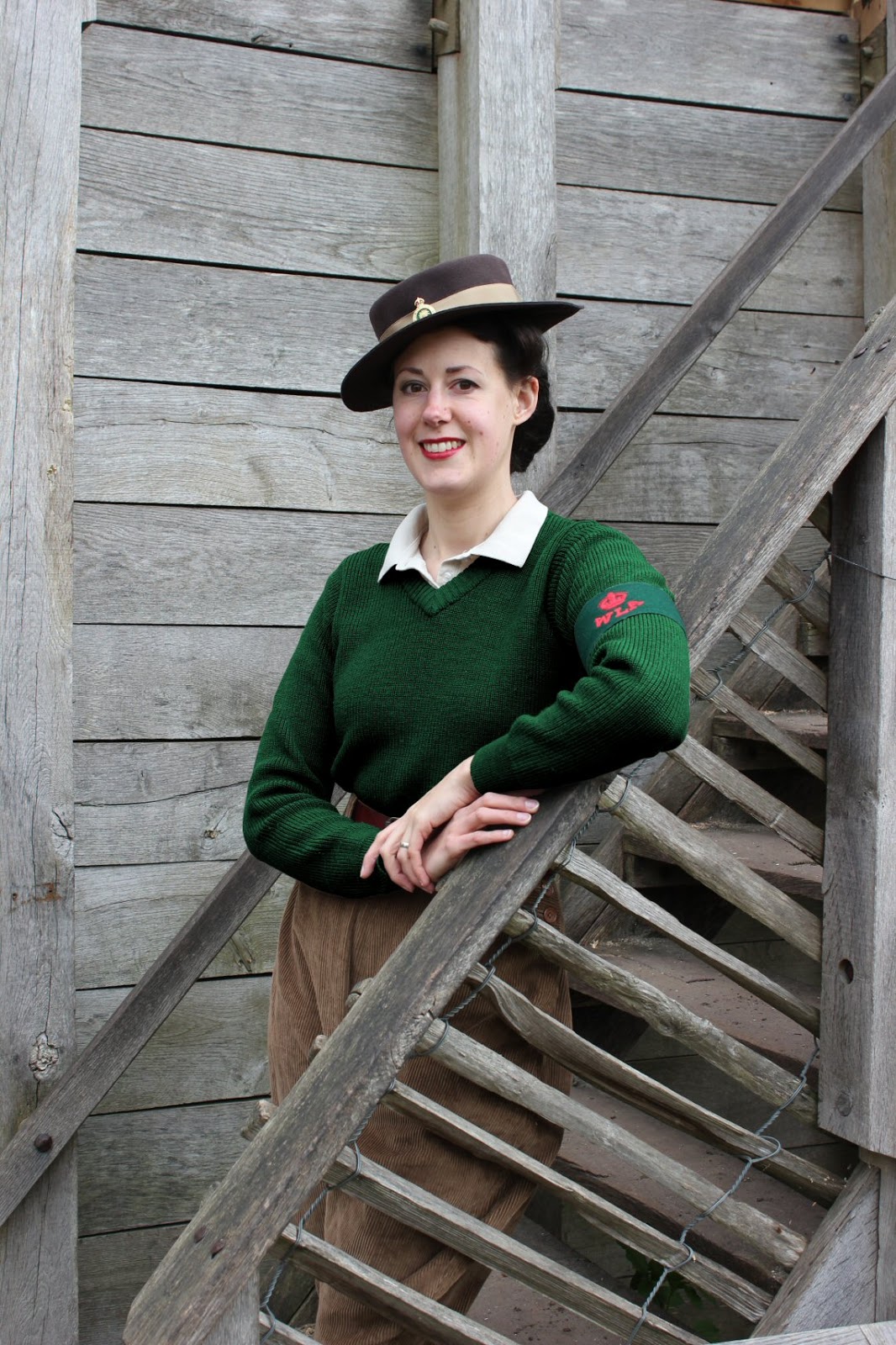
And here I am putting the jumper to the test at the archeological theme park Archeon with my full WLA uniform!


Took the park’s flying broom for a spin…

And, why not, a glamour photo. Because the WLA offered a healthy, happy job that did not involve 12+ hour days doing hard work in the mud, right?

If you want to read an interesting book about the WLA, I can recommend this one: