Showing posts with label dyeing. Show all posts

Saturday, 31 August 2019

1940s half slip


Pattern: improvised
Fabric: white viscose dyed powder pink
Haberdasheries: two snaps, one hook, 1.4 m light pink lace, elastic for the waist

Hey y’all, I took a bit of a break from blogging because it was feeling too much like a chore and I wanted to focus more on sewing rather than writing about it. But now I’m back and have quite a few unblogged projects, so you can expect many more posts the coming time.

One of the things I’ve made is a 1940s half slip. I improvised the pattern, which is a simple A line skirt. I used a white viscose fabric which I dyed powder pink using Dylon fabric dye in the colour powder pink :P. Strangely this colour, among a few others, is not sold in my country so I had to get it from eBay. I used this colour before to dye some granny underwear from Hema that I use with 1940s clothes (see here) and the colour turned out much brighter, and also a different shade (less peach pink), on that cotton fabric than on this viscose, but the resulting very light pink was what I was going for. It’s a classic 1940s underwear colour.


I made French seams because the fabric is quite thin and sheer, and a placket with snap fasteners and a hook and worked eye to close the slip. I might replace the snaps with more hooks and eyes though, because they have a tendency to pop open when I sit down!


I learned a ‘couture’ technique for sewing on hooks for this project. Doesn’t it look nice?

Wednesday, 19 June 2019

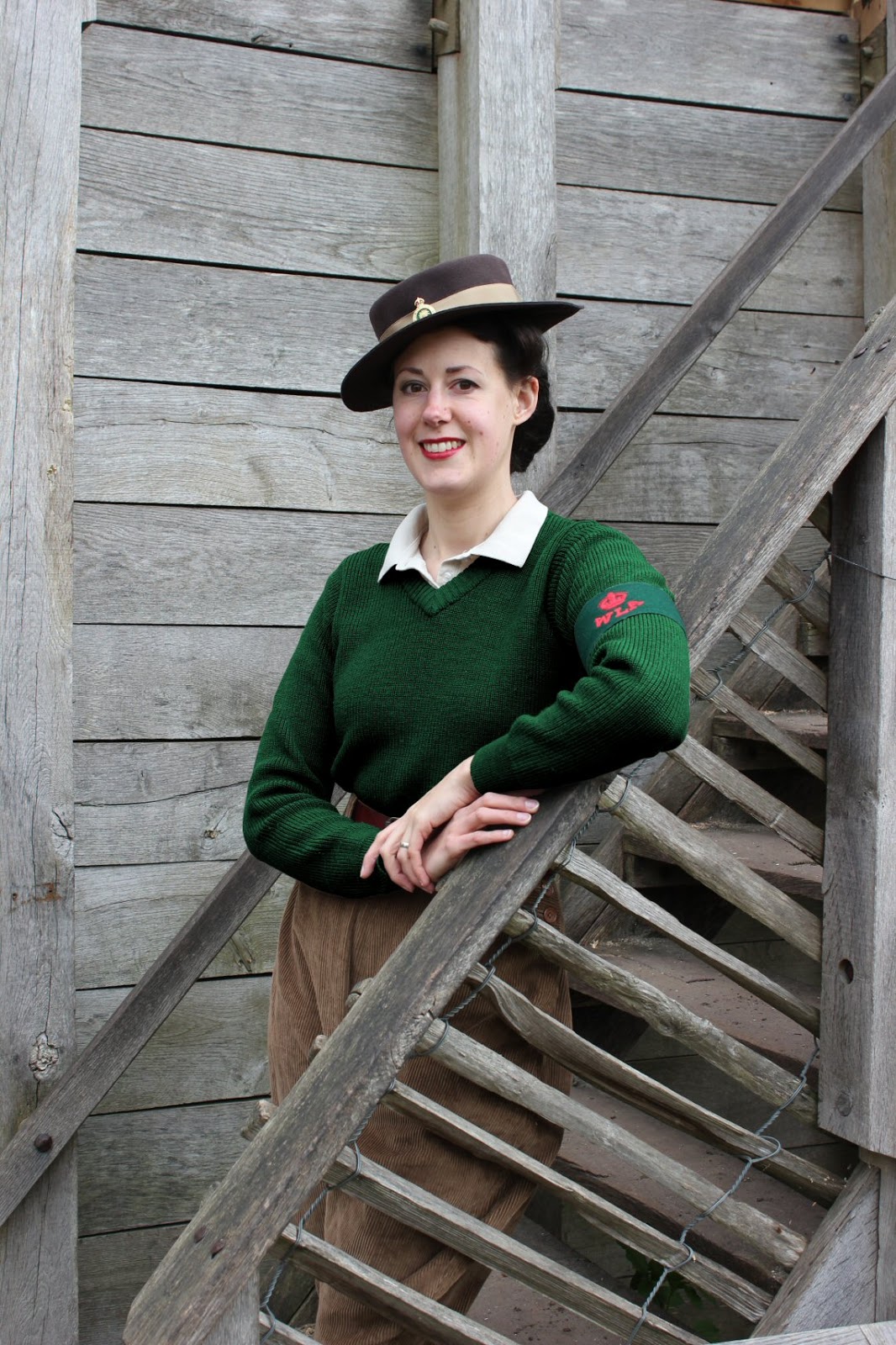
Women’s Land Army jumper – and how you can make your own!

Pattern: none
Fabric: a 100% wool knit Dutch army sweater
Haberdasheries: none


Yes, finally I’ve got a WLA jumper! (And finally my uniform contains one piece that is actually my colour! :P) In my opinion this is one of the hardest WLA uniform pieces to obtain, because there are no good reproductions available. Some web shops do offer them, but unfortunately the only thing they’ve got in common with the real thing is that they’re green and sometimes ribbed. However, they’re always made of cotton whereas original WLA sweaters were made of wool (and I know which I prefer for re-enactment events as well!), and even if they’re ribbed, the rib used is not the same at all.

So I’d been thinking about how I was going to make a good WLA jumper. There were hand knitting patterns for them at the time, but I didn’t feel like knitting one because frankly, an entire sweater in k1p1 is just boring! Then my husband mentioned he had an old Dutch army sweater lying around that he wasn’t using anymore, and it turned out to be 100% superwash wool and exactly the right fisherman’s rib!

This is what the sweater looked like, nice Dutch flag and all :P:


I removed the stitched on cotton pieces and took the jumper apart, then sewed it back together, making it much smaller. Luckily, as the army sweater was too long anyway, I could omit using the part of the body which had the shoulder pieces, as the stitching left dents which even blocking didn’t remove. This was also the case with the sleeves, but I couldn’t avoid using those bits.

Creating the v-neck collar took the most effort. I carefully took off the collar, threading all its loops with scrap yarn, then made the v-shape and hand sewed the collar onto the jumper, taking care to reattach each loop.

And then all that had to be done was dyeing the jumper the correct shade of green! I say ‘all’, but this took some experimentation. I had experience with Dylon textile dye and although it isn’t meant specifically for wool I assumed it would work. The packaging says that ‘lighter shades will be achieved in wool’, so I thought I’d just add a bit more dye than specified. I did several dye tests on leftover bits of the army sweater, using varying ratios of Dark Green, Emerald Green and Tropical Green – and found that using Dylon in a lighter, bright colour in order to add intensity doesn’t work at all. Eventually I got a relatively bright green, but I had used so much Dylon dye to achieve this in the sample that to dye the entire jumper would have taken 50-70 euros worth of dye! Obviously that wasn’t an option, so I searched online for dye that was meant specifically for wool, and came across STV Jaquard wooldye. I ordered one bag in the colour ‘vogelmuur’ (chickweed – heh, that’s actually appropriate for the WLA in more ways than one!). 20 grams, that was supposed to be more than enough to dye my 425 g jumper. I found that hard to believe. Also, the fabric had to be heated to 98°C for the dye to work properly, and I assumed it would felt, or at least shrink. But I used 1 gram of dye for another sample and it came out the perfect colour, with seemingly no shrinkage!

My dye tests. Top left is the original colour of the army sweater, 1-4 are tests with Dylon and bottom right is the final test, using wool dye

Dyeing the entire jumper with the wool dye was still a bit tricky because the largest pan I own was only just big enough to fit the jumper and enough water to cover it; it was a more cramped space than is usually the case when I use Dylon in my sink and I couldn’t really stir the jumper properly, so I was afraid it might end up with a slight tie-dye effect of more intense colour in some places than others. Also, despite using a meat thermometer, the pot accidentally started boiling. But despite all this, the jumper cane out absolutely perfect! I’m quite astonished by the quality of this dye, how little of it I needed and how even the result was despite the jumper being in the pan all crumpled. I had hoped the original olive green of the army sweater could be transformed to bright dark green, but I didn’t know this brightness would be possible and any colour at least darker than olive would have been ok. So I’m chuffed with this result =).

And here I am putting the jumper to the test at the archeological theme park Archeon with my full WLA uniform!


Took the park’s flying broom for a spin…

And, why not, a glamour photo. Because the WLA offered a healthy, happy job that did not involve 12+ hour days doing hard work in the mud, right?

If you want to read an interesting book about the WLA, I can recommend this one:

Thursday, 22 December 2016

On dyeing clothes


Earlier this year I used fabric dye for the first time, and since then I’ve had some really good results, so I thought I’d share what I’ve dyed so far.

I think I first got the idea of trying out fabric dye when I ordered a lingerie set online, and its colours turned out to be very disappointing in real life, but returning it wasn’t really an option. It seemed grey and pastel pink in the pictures, but turned out to be grey and salmon colour. I’m a bit allergic to salmon colour because when we moved into our house most of the woodwork was painted in that colour and it was a pain to paint over, but even if that hadn’t been the case – grey and salmon for underwear, really?! Anyway, the lingerie wasn’t cheap so obviously I wasn’t going to try fabric dye for the first time on something like that, so I picked some old shirts I wasn’t really wearing anymore and dyed them first. It’s interesting that while I now know which colours suit me (I’m a deep winter type), I think I did at least partly realise before that these colours did not suit me. Because I liked these clothes when I bought them, but for some reason I didn’t wear them a lot.

These are the clothes I picked to try out the dye (seeing them together in one photo makes me wonder how I could think those were nice colours at all…), the lingerie set and a black and white shirt I bought specifically for dyeing, as I got a little overenthusiastic at the thought of the possibilities:


I used Dylon hand wash dye, and followed the instructions on the back of the packages of dye to the letter. I used the special Dylon salt – I’m not sure whether it is actually any different to regular table salt, but it isn’t expensive so I didn’t want to risk getting less good results due to not using it. Also, I weighed 250 g of salt rather than adding the much less exact five tablespoonfuls, the other suggestion on the package (I weighed five regular tablespoons full of salt, and that was only about 125 g!). I used a cooking thermometer to approximate the instructed water temperature of 40°C, although this is the one thing that I started taking some liberty with when I got more dyeing experience, and it seems that hotter water is fine, or perhaps even yields better results. I also stirred the cloth in the dyeing solution consecutively for 15 minutes, and left it in for another 45 minutes.

This is the first shirt after dyeing it Intense Violet:


Most clothing is sewn using polyester thread, and that doesn’t take the dye, as you can clearly see on the inside of this shirt; however, I don’t find it very visible on the hem.

 
After this first successful attempt I dyed the black and white striped shirt, and a knit lace cardigan Flamingo Pink:


The cardi turned out exactly as I had hoped. I did have to replace the buttons, of course! Even though these dyes are meant for dyeing white fabric into the colours pictured on the package, I found the pink stripes on the shirt a bit too light, despite the weight of the clothes being exactly right for the amount of dye in one package.

By now I kind of felt confident enough to dye the lingerie set, and here’s the result, again using Flamingo Pink:


Obviously, the closure and shoulder straps are synthetic and didn’t change colour. I hadn’t really taken that into consideration, but I don’t mind, because I think I’m really lucky with how this set turned out! I don’t think it could have turned out better. I wasn’t entirely sure that the embroidery wasn’t polyester, but apparently it’s rayon, and it took the pink dye very well. Again, I had to replace the bows, which were synthetic and remained salmon coloured, but happily I found a matching satin ribbon.

I then dyed some granny underwear from Hema, which I think closely resembles more casual 1940s underwear, using Powder Pink, so it matches my other 1940s undies. This dye could have been a bit more towards lilac for me, and less towards orange.


Then I dyed a nightgown.


This turned out a VERY Intense Violet indeed, much more so than the first shirt I dyed in this colour. I thought I needed one package of dye for it, but it turned out it actually weighed less than the 250 g one package is intended for, so that must be why.

And finally, I decided to revive a not so old but very faded pair of jeans, using Navy dye.


I ripped the bottom hem because the jeans were a bit too long, and this way I hoped they’d take the dye evenly. I think it worked rather well. I shortened the jeans a little and rehemmed them with matching thread.


Here’s the top of the jeans. In this case, it’s a good thing that the thread doesn’t take the dye:


The only time I didn’t get satisfactory results, or any results at all, in fact, was when I tried to renovate some black clothes. I helped my mum do so first, and we used the same amount of black dye we would have needed to dye white clothes black, which, looking back, seemed a bit wasteful. So I tried to renovate a black sweater and a thin black shrug using just one package of dye, but apparently that was much too little. Therefore, when renovating my jeans, I again used the amount of dye required to dye white jeans navy.