Showing posts with label Napoleonic. Show all posts

Saturday, 12 May 2018

Regency short cloak – and a new apron


Pattern: improvised
Fabric: dark green wool, leftovers from 17th century cape
Haberdasheries: 1.1 m dark green twill tape


After I made the 17th century cape for my husband, I realised I could do with a warm item in my camp follower’s wardrobe, and could use the leftovers to make it. I had 2.5 m of fabric originally, of which I used 1.9 m for the 17th century cape, but I easily managed to get a short cloak for myself out of what was left =). Mine’s just got a seam down the back, but that’s totally realistic, as piecing was normal back then, especially for a working class person’s attire.


Again, the pattern was improvised and is a simple half circle, except that I added a gathered 15 cm of extra fabric at the back. This cape is also a bit shorter than my hubby’s. I cut a half oval out of the back for the neckline and attached a collar consisting of two strips of fabric measuring about 12.5 by 52.5 cm. I initially wanted to make the collar the same as the one on the 17th century cape, but decided to make it more rounded, for a more feminine look.
Finally, I lined the cape and attached two pieces of cotton twill tape to close it. Easy!


This is the  first Make Nine project I’ve finished!

Oh, and I made a new apron:

Wednesday, 28 February 2018

My Make Nine 2018 choices


A few years ago I took part in Lucky Lucille’s Sew For Victory and Spring For Cotton sewalongs. Here’s another one that seems nice to take part in, especially as her website states “This is a gentle challenge. It’s not one that you can fail. It’s meant to be flexible”! =) I’ve been trying my best not to stress myself by imposing deadlines on myself anymore, so a gentle challenge is the only thing I want to be going for…

Here are my choices, though in no particular making order!


Project #1: 1920s-40s knitted men’s slipover
I’d like for my husband to have a full civilian outfit for both the 1920s and 1940s, and this is the first part of it. This project’s already on the needles!

Project #2: Napoleonic short cloak
Last year I made a 17th century cape for my husband, and I’ve got enough left of the wool fabric to make myself a short cloak for another era. Since I always borrow his Napoleonic cape, it would be nice for both of us if I had one of my own!

Project #3: A new 1940s dress
I’ve been (occasionally) doing World War 2 events for a few years now, but there aren’t that many clothes in my 1940s wardrobe yet, and even fewer that are a colour that actually suits me! So I want to make a new 1940s dress in a nice bright colour pattern. My husband and I have been taking 1910s-40s dancing lessons, and I'd like to go to a lindy hop party in full 1940s attire.

Project #4: 1920s party dress
Last year I went to a nice historical clothing exhibition at the Centraal Museum in Utrecht (well, actually it was both historical and more recent fashion, but I largely ignored the contemporary pieces! :P), where I saw, among other things, this lovely 1920s dress that I’d like to recreate. Probably in blue, though. I’d love to wear this dress to a 1920s party!

Project #5: The Drawers of Doom
(Imagine dramatic background music) These are the drawers of my fabric cupboard. There are four of them. And since they are full of UFOs and bought clothes needing alteration (yes, all four of them!) I call them the Drawers of Doom (D.o.D.). This year, one of the main sewing related things I’d like to do is to get the D.o.D. a lot emptier than they are now! Then I could do something nice and handy with these drawers, such as storing my yarn stash in them =).

Project #6: Brasov wrap top
I really like Welmode’s Brasov top, and would like to make one as well.

Project #7: Underwear!
For years now, I’ve had trouble finding nice underwear, so I thought I’d have a go at making it myself. It would be awesome, once I’ve got a good pattern, to never have to look for underwear that it exactly to my liking, again!

Project #8: WW2 QAIMNS uniform
I’ve got two World War 1 nurse uniforms, and a Boer War one, and since I already bought suitable fabric for a WW2 version a couple of years ago, and had a look at an original last year, why not make the WW2 one as well? I suppose this project has the lowest priority, though, as I haven’t got any WW2 nurse events planned yet.

Project #9: It Cannot Fail To Please sweater
As I said under #3, I’m hoping to add more deep winter colours to my 1940s wardrobe, so I’ll be making this in dark pink.

Tuesday, 30 May 2017

Wool Regency jacket with patchwork lining


Pattern: improvised
Fabric: Purple wool, lots of scraps for lining
Haberdasheries: 2,5 m narrow tape for drawstrings

A few years ago I made my first working class or camp follower’s Regency outfit, including a wool jacket, but I was never quite happy with how the jacket turned out. Now I’ve made a few alterations to it, and also added lining in the way it would have been done in the day – that is, using leftover pieces of fabric.

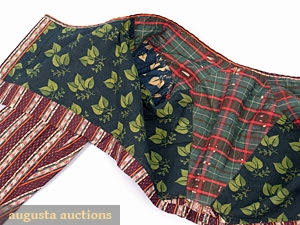
Three examples of patchwork lining from the period:

http://www.metmuseum.org/art/collection/search/155096?img=1&imgno=3&tabname=related-objects
https://www.augusta-auction.com/component/auctions/?view=lot&id=9044&auction_file_id=10
 
https://whitakerauction.smugmug.com/Spring2013/Clothing/ID-22-285/i-qqsvPLD

And here's my patchwork lining:


Some of the ‘scraps’ I bought especially for this purpose, but I also used the leftovers of my patterned fichu, pockets and a knitting huswife. So I was limited by the size and shape of the fabric, and it was actually quite a puzzle to put all the pattern pieces together.

A nice detail, I think, is that you can see a different lining fabric inside each sleeve when I wear the jacket.


Because I wanted this jacket to be warm, I initially made the neckline quite high. But besides not looking particularly elegant (and even as a camp follower, one can strive to look elegant!), a high neckline is just not typical for the Regency period. So I lowered the neckline by about 4 cm, and took some fabric out of the back panel to make the sleeves start neatly on the shoulders, rather than hanging off them a bit (the only downside to this is that the sleeves, which were very long, another typical Regency thing, are now a bit shorter). I also added different drawstrings at the neckline and at the waist, using the Katia Tahiti knitting yarn that I bought for the previous campfollower’s jacket I posted. It matches these lining fabrics nicely.


And worn with an apron.


This earlier picture is just one example of this typical manner of wearing the apron, crossing the straps at the back and tying them at the front. This was probably done because working class women didn’t have a maid to tie the straps at the back!

Saturday, 29 April 2017

Red linen Regency jacket


Pattern: Past Patterns #031, 1796-1806 front closing gown, heavily modified
Fabric: Dark red linen, coarser natural-coloured linen for lining
Haberdasheries: 3 pairs of hooks and eyes, 1.5 m narrow tape
A first: Constructing and lining a Regency jacket entirely authentically


This camp follower’s jacket was a UFO for years. I don’t even remember when I started making it, but I just didn’t think it was turning out right, and that put me off finishing it.
Then I wanted to use it for the March challenge of the Historical Sew Monthly which I briefly took part in in 2015, but decided to quit that. I promised myself a while ago that I wouldn't set deadlines for myself anymore because they make sewing stressful and definitely no fun for me, and this sewalong provided a fresh deadline every month. I really don't want that!

I think that while this pattern has really nice parts, like the lovely kite-shaped back panel, and the instructions for the well-fitting fichu, its waistline is much too low. This is a pet peeve of mine as far as Regency reproductions are concerned, anyway – the main characteristic of the fashion of this period is that high waistline, after all! – so I always try to get my waistline properly high, and the bodice fitting quite tightly, rather than hanging in any way. Consequently, I modified the pattern quite a bit, removing 6 cm from the lower edge of the bodice.
As I didn’t want puffy sleeves, I used a smaller version of the sleeve than I did of the bodice, and lengthened the sleeves as well.

I really like the fact that the historical construction of this pattern creates a slightly recessed back panel, so I followed the instructions for the sewing and lining technique to a tee. I also topstitched the back panel by hand (the demotivating part of which is that if one does it neatly enough, it looks like a sewing machine was used!). But I didn’t find the instruction on how to create those nice square lines between the sleeves and the bodice particularly enlightening. In any case, I put the sleeves in and ripped them out again several times, but did not manage to create anything quite like in the pattern picture. If anyone knows how to do this, I’d be interested to know!


My annoyance over the sleeves was one reason why this project UFOed for so long, but recently I picked the jacket up again and had some inspiration about things I chould change to make myself like it enough to wear it. Firstly, I used one width of fabric for the skirt part of the jacket, and that isn’t enough to make it stand out nicely. Too little fabric gives a column-like shape. So I used my leftover fabric to add 50 cm more width, and moved some of the pleats to the side of the jacket as well.
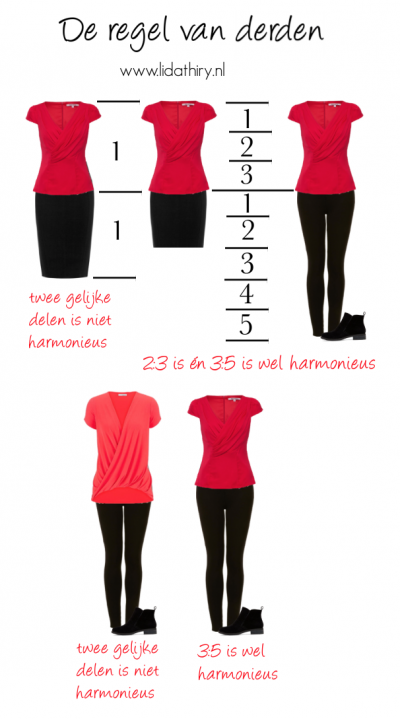
Secondly, the length of the jacket wasn’t right. I came across this information on proportions in clothing (saying that in clothing, two parts of equal length do not constitute a 'harmonious' look, whereas 2:3 and 3:5 are harmonious):

And my jacket was the same length as the part of the dress visible below it. So I shortened the jacket, and as trivial as that may seem, it really made a difference.


For the drawstrings that close the jacket, I wanted to use narrow tape made of a natural material (the authentic option, but also, polyester ribbons tend to come loose), but I could only find bright white tape. Then I found Katia Tahiti knitting yarn in colour 8, which is made of cotton, seems durable, and is just perfect for this purpose! And only €0.09 per m.

 
As the front flap closure, I sewed on three wire hooks and eyes.


Because I started off constructing this jacket entirely historically, I found it a nice challenge to finish it using only old-fashioned techniques, as well. So I finished the raw edges by overcasting by hand. As I was doing this I thought it looked hideous, but now I think it’s a nice historical detail.


I intend to make more working class Regency jackets using this pattern, but I think I will start over with the pattern, making another toile and modifying it a bit differently. For instance, I won’t make the shoulder straps wider next time (no idea why I did that anyway!), and I’ll leave the bodice slightly longer, to make my back look a bit narrower. It’s 1817 now anyway, when waistlines were descending again!